Skip to searchSkip to main content

State Bank of India Mutual Fund

Company Overview
Balance Sheet Analysis
Cash Flow Statement Analysis
Profit & Loss Statement Analysis
Financial Insights
Premium Insights
Company Overview
Balance Sheet Analysis
Cash Flow Statement Analysis
Profit & Loss Statement Analysis
Financial Insights

  • Steady Compounder:  Revenue growing at a consistent 20.0% CAGR, mirroring the systematic inflow of SIPs in India.
  • Moat Indicator: Maintains a 59.8% Net Margin. Asset Management Companies (AMCs) are incredibly scalable—costs don't rise much as Assets Under Management (AUM) grow.
  • Heavy Reinvestment: CapEx is 63% of Revenue, likely invested in digital infrastructure to capture the retail investor boom.
  • Zero Debt: Completely debt-free balance sheet.
Premium Insights

Fundamentals

SBI Mutual Fund  Unlisted Shares Price ₹ 775 Per Equity ShareMarket Cap (in cr.)₹ 157437
Lot Size
  100 SharesP/E Ratio62
52 Week High₹ 2775P/B Ratio18.97
52 Week Low ₹ 675Debt to Equit 0
DepositoryNSDL & CDSLROE (%) 30.61
PAN Number AAACS7339DBook Value40.85
ISIN Number INE640G01020Face Value1
CIN U65990MH1992PLC065289Total Shares 2031443768
RTAComputer Age Management Services (CAMS)

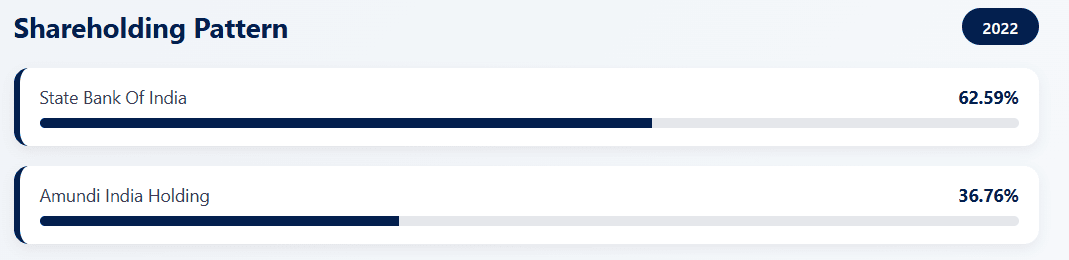
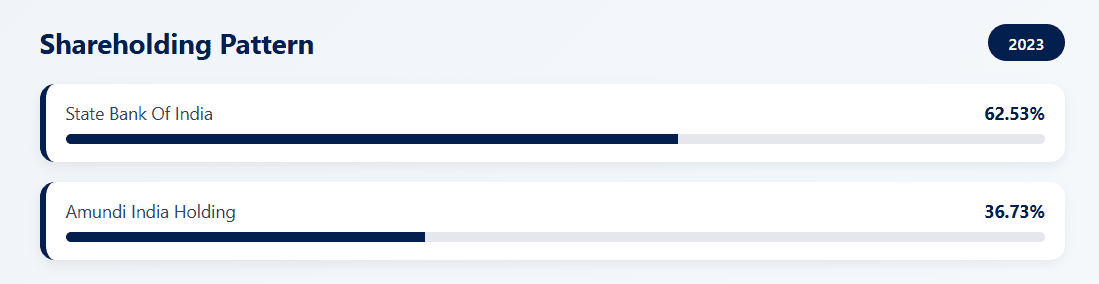
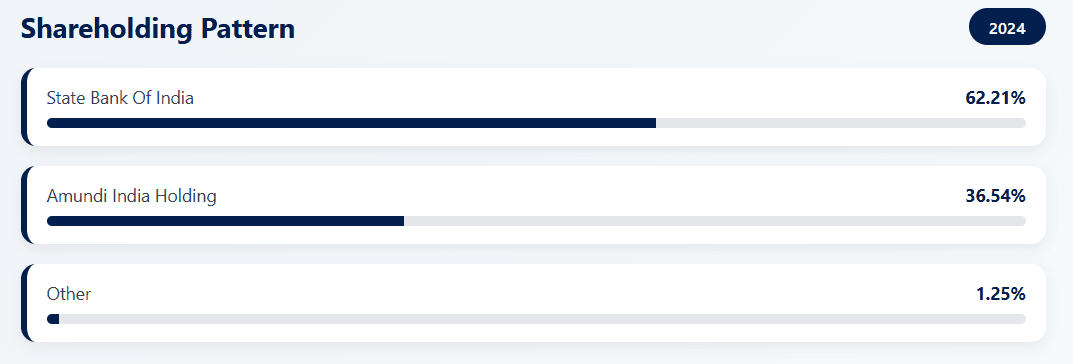
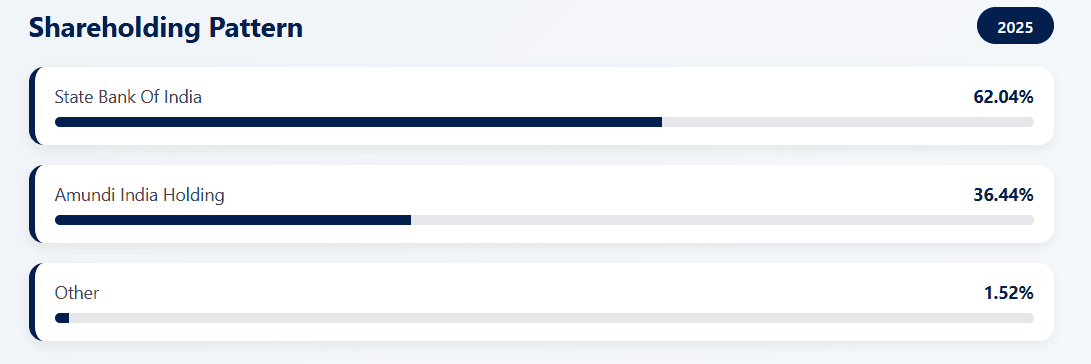
Shareholding Pattern

2022
2023
2024
2025
2022
2023
2024
2025

State Bank of India Mutual Fund

Established in 1987 as a joint venture between State Bank of India and France’s Amundi, SBI Mutual Fund is one of India’s largest and most trusted asset managers. Headquartered in Mumbai and led by CEO Nand Kishore, it manages over ₹10.38 lakh crore in assets as of 2025. The firm offers a diverse portfolio of 80+ schemes, including equity, debt, and innovative ESG-based funds, serving over 26 million investor folios.

By combining SBI's massive domestic retail reach with Amundi’s global expertise, the company has secured a top-three market position. Known for disciplined risk management and ethical governance, it maintains a nationwide presence across 290+ branches.

Company Business Model

SBI Mutual Fund operates an asset management business model, managing investor money across diversified investment schemes and earning fee-based income.

Mutual Fund Scheme Management

Manages equity, debt, hybrid, liquid, and passive (ETF/index) funds for retail and institutional investors.

Asset-Based Fee Income

Earns revenue through management fees (AUM-linked) charged on funds managed.

Fund Distribution Network

Leverages SBI’s vast banking network, distributors, and digital platforms for scale and low-cost customer acquisition.

Investment & Risk Management

Uses professional fund managers and research teams to generate returns while managing market and credit risk.

Competitors

SBI Mutual Fund competes in India’s asset management industry with the following major AMCs:

HDFC Mutual Fund

One of India’s largest AMCs with strong equity, debt, and hybrid fund performance.

ICICI Prudential Mutual Fund

Diversified AMC with a strong presence in retail, institutional, and passive funds.

Axis Mutual Fund

Known for strong equity fund performance and growing SIP investor base.

Kotak Mahindra Mutual Fund

Offers a broad range of equity, debt, and passive investment solutions.

SWOT Analysis

Strengths

  • Largest AMC by AUM in India : Market leader with massive AUM scale, providing strong fee stability and operating leverage.
  • Powerful SBI Brand & Trust : Backed by State Bank of India, offering unmatched credibility, reach, and investor confidence.

  • Extensive Distribution Network : Leverages SBI’s nationwide branch network, plus distributors and digital channels.

  • Diversified Product Portfolio : Strong presence across equity, debt, hybrid, liquid, and passive funds, reducing volatility.

  • Sticky Retail SIP Base : High share of long-term SIP investors ensures predictable inflows.

Weaknesses

  • Lower Yield on Large AUM : Size can limit agility and alpha generation in certain equity strategies.
  • Expense Ratio Compression : Regulatory caps and passive fund growth pressure margins.

  • High Dependence on Equity Markets : Market downturns impact AUM and fee income.

  • Public-Sector Perception Risk : Some investors perceive slower decision-making vs private peers.

Opportunities

  • Financialization of Household Savings : Shift from physical to financial assets fuels long-term AUM growth.
  • SIP & Retail Penetration Expansion : Untapped semi-urban and rural markets via SBI branches.

  • Passive & ETF Growth : Rising demand for low-cost index products boosts scalable AUM.

  • Institutional & Retirement Assets : Growth in pension, EPFO-linked, and long-term institutional mandates.

Threats

  • Intense AMC Competition : Strong peers like HDFC MF and ICICI Prudential MF compete on performance and pricing.

  • Market Volatility Cycles : Prolonged bear markets reduce equity AUM and inflows.

  • Regulatory Risk (SEBI) : Changes in TER norms or commission structures can impact profitability.

  • Shift to Passive Investing : Lower-margin products may dilute revenue growth.