National Commodity & Derivatives Exchange
Fundamentals
| NCDEX Limited Unlisted Shares Price | Rs 458 Per Equity Share | Market Cap (in cr.) | Rs 4108 |
| Lot Size | 500 Shares | P/E Ratio | 17.41 |
| 52 Week High | Rs 525 | P/B Ratio | 5.41 |
| 52 Week Low | Rs 210 | Debt to Equit | 0 |
| Depository | NSDL & CDSL | ROE (%) | 31.48 |
| PAN Number | AABCI9479D | Book Value | 84.7 |
| ISIN Number | INE127G01010 | Face Value | 10 |
| CIN | U51909MH2003PLC140116 | Total Shares | 896949730 |
| RTA | Link Intime |
Shareholding Pattern
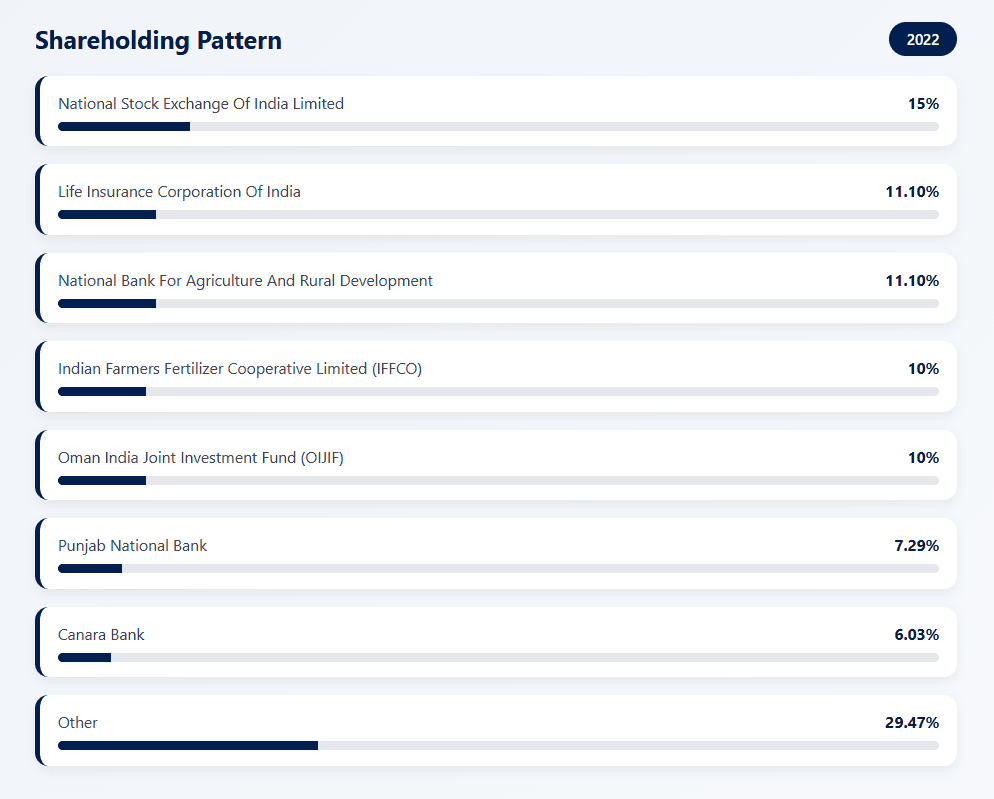
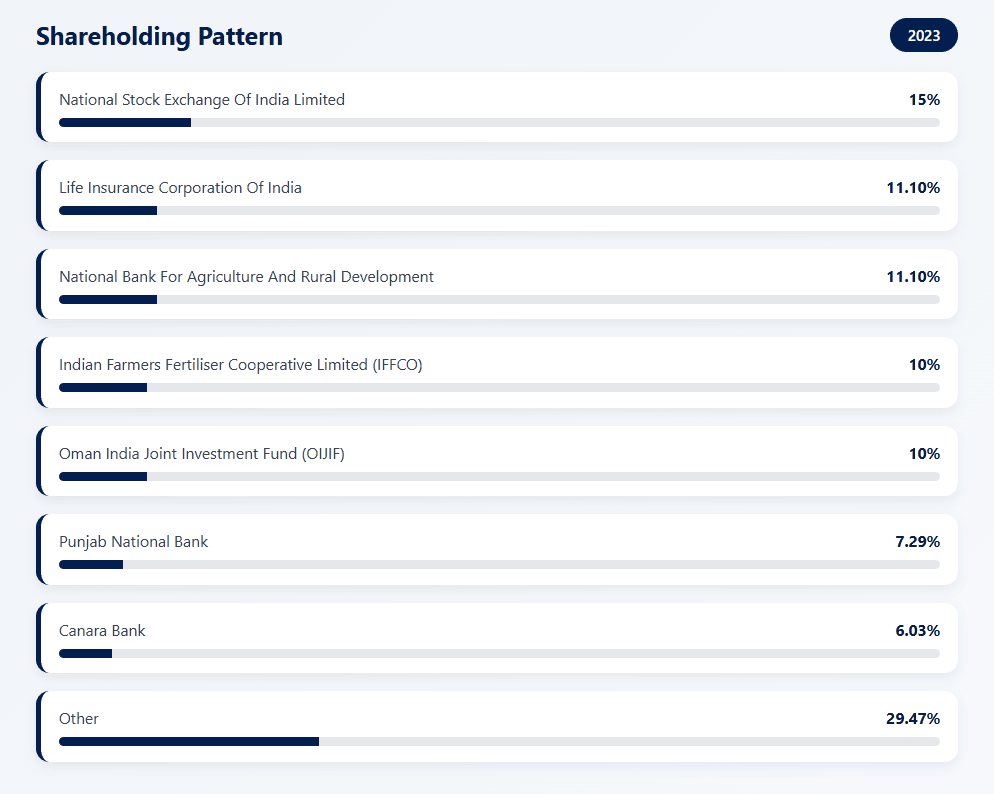
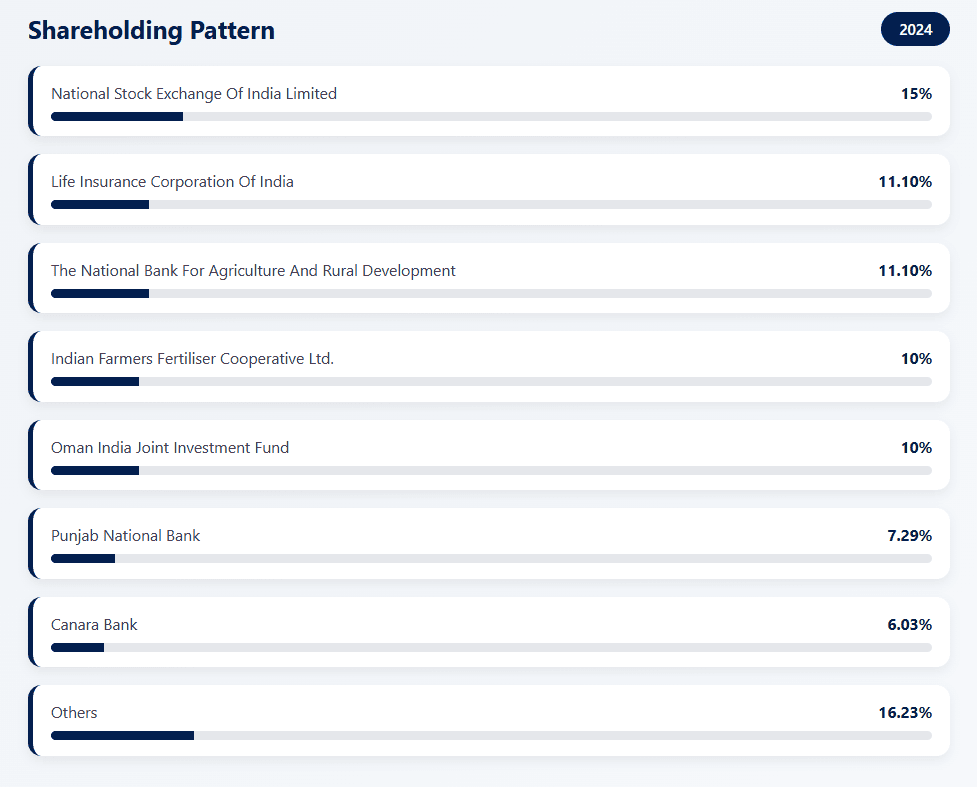
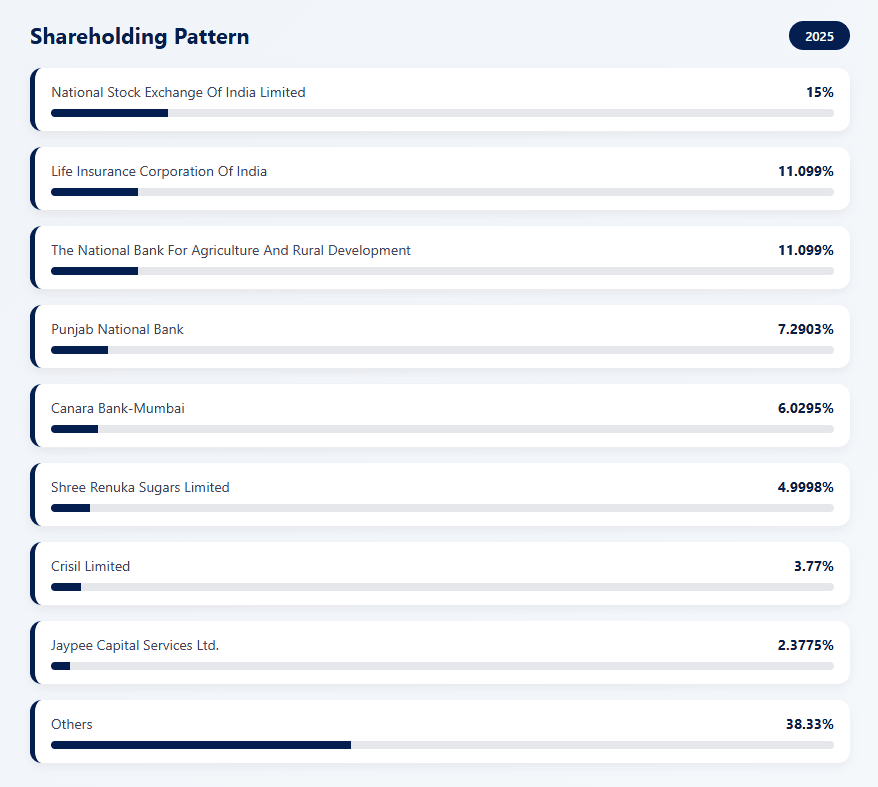
National Commodity & Derivatives Exchange

Established in 2003 and headquartered in Mumbai, NCDEX is India's leading online exchange specializing in agricultural commodity derivatives. Regulated by SEBI, it provides a transparent platform for trading futures and options on over twenty commodities, including soybean, mustard seed, and turmeric. Key institutional backers include LIC, NABARD, and the NSE, ensuring a robust financial and regulatory foundation.
The exchange plays a vital role in global price discovery and risk management, with several contracts serving as international benchmarks. Through subsidiaries like National Commodity Clearing Ltd., it offers an integrated infrastructure for electronic settlement and warehousing. By reducing information asymmetry, NCDEX empowers farmers and traders while utilizing high-availability, Tier IV data center technology for seamless trading.
Company Business Model
The National Stock Exchange of India operates a multi-revenue financial market infrastructure business that enables trading, clearing, settlement, and data dissemination across capital markets.
Trading Platform Operations
Provides an electronic platform for trading agricultural commodity futures and options, earning revenue through transaction fees.
Clearing & Settlement Services
Ensures risk management, margining, and guaranteed settlement of trades through its clearing mechanism, generating clearing and settlement charges.
Market Data & Index Services
Monetizes real-time and historical commodity price data sold to brokers, traders, institutions, and agri-market participants.
Membership & Exchange Services
Earns fees from exchange memberships, connectivity, and compliance-related services offered to trading members.
Competitors
NCDEX operates in India's commodity derivatives space and competes with the following exchanges:
BSE Limited
India's oldest stock exchange, competing with NSE in equity trading, derivatives, listings, and market data services.
Multi Commodity Exchange of India
The largest commodity exchange in India, dominant in non-agricultural commodities (metals & energy) and an indirect competitor across derivatives participation.
Indian Commodity Exchange
Competes in select commodity derivatives, with limited volumes compared to NCDEX and MCX.
National Stock Exchange of India
An indirect competitor through its commodity derivatives segment, leveraging strong technology and broker network.